Building & leading a functional creative org from scratch at a high-growth healthtech startup
Overview
A team that scales 350% in 2 years needs process!
Just a few months after getting hired at CareRev as their founding Creative Director in 2020, CareRev got funding. And when I say funding, I mean FUNDING: they reached $50 M Series A by 2021. And, by 2022, our creative organization exploded from a single member to a team of 14 creatives, including art directors, visual designers, copywriters, and product designers! Not to mention, CareRev's Product and Marketing orgs increased exponentially as well. Given the increase in headcount, company goals, and product needs, I addressed emerging team growth friction and needs through process updates, organizational workflow, and cultural support.
This case study focuses on the overall process, rather than each specific nuance. If you're interested in any particular workflow, its own case study can be made available by request!
Challenges
High-growth = chaos
My team wasn't the only one growing. We were a health tech company in 2020, which meant demand was very high! With every opportunity comes a challenge, of which there were many:
I was the only manager on my team: Budgets accounted for growing teams for headcount, not for seniority. So, this meant that I needed to come up with a way to utilize designer talent efficiently, and at the same time provide paths for upskilling and career growth.
The company kept changing: Unsurprisingly, high-growth startups need to change and adjust far more often than more established companies. CareRev was no exception. I needed to adjust my own processes accordingly, and ensure that they were more flexible to anticipate any instability.
There was high executive turnover: Changing organizational needs also meant that our leadership structure and strategy changed quite often. My own role remained in-flux as my reporting structure would often change every few months...and, along with it, the role my team would play in the company's overall strategy.
What I built
There's more than one way to grow
It's like Bruce Lee says: "Be like water making its way through cracks." I approached building my team through two lenses: an Agile approach to collaboration, and Atomic approach to systems. Our Agile approach would aim to strengthen team dynamics, and reduce duplicative efforts. Our Atomic approach would focus on core issues first, radiating out to larger moving pieces. Like the Japanese art of fortifying cracks with gold, "Kintsugi," our Creative organization would fill gaps as-needed, and change shape depending on the problems at-hand.
Workflow #1: Working structure strategy
Goal: Growth
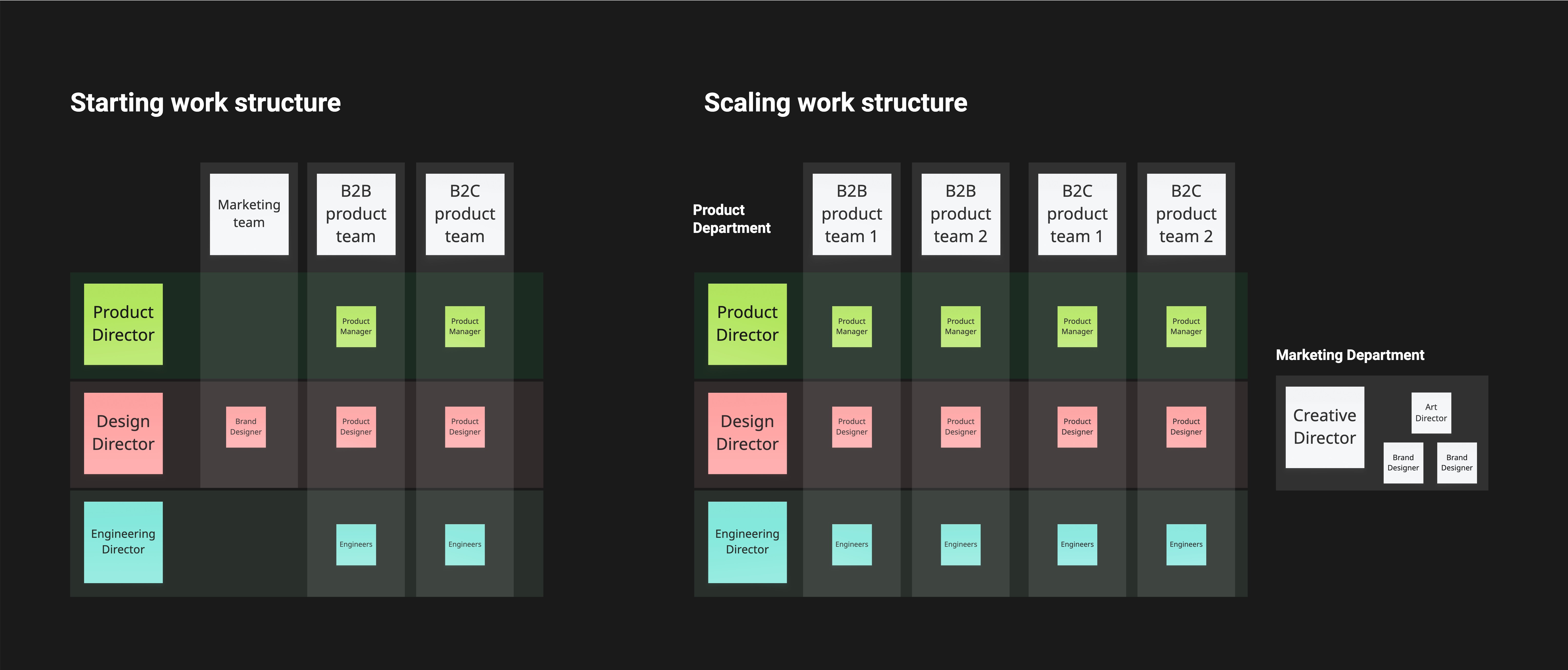
As joint effort, I worked with our founding Product Managers and Engineering Managers to research and discuss what the best structure to work on CareRev's product suite together would be. This would inform our hiring strategy at scale. After much deliberation, a semi-distributed team structure was decided upon to account for the hyper-growth we were experiencing. Essentially, department heads would remain centralized, while individual contributors would be embedded onto product-specific teams. Trade-offs for this solution were identified and accepted by all parties:
Higher risk of siloed efforts
Greater likelihood of inconsistent patterns in the products' design
Since both of these trade-offs affected my team significantly, I created support and resources in the attempt to counter these risks as much as possible (see Workflow #3).
Starting and scaled working structure plans
Workflow #2: New hire onboarding
Goal: A supportive culture
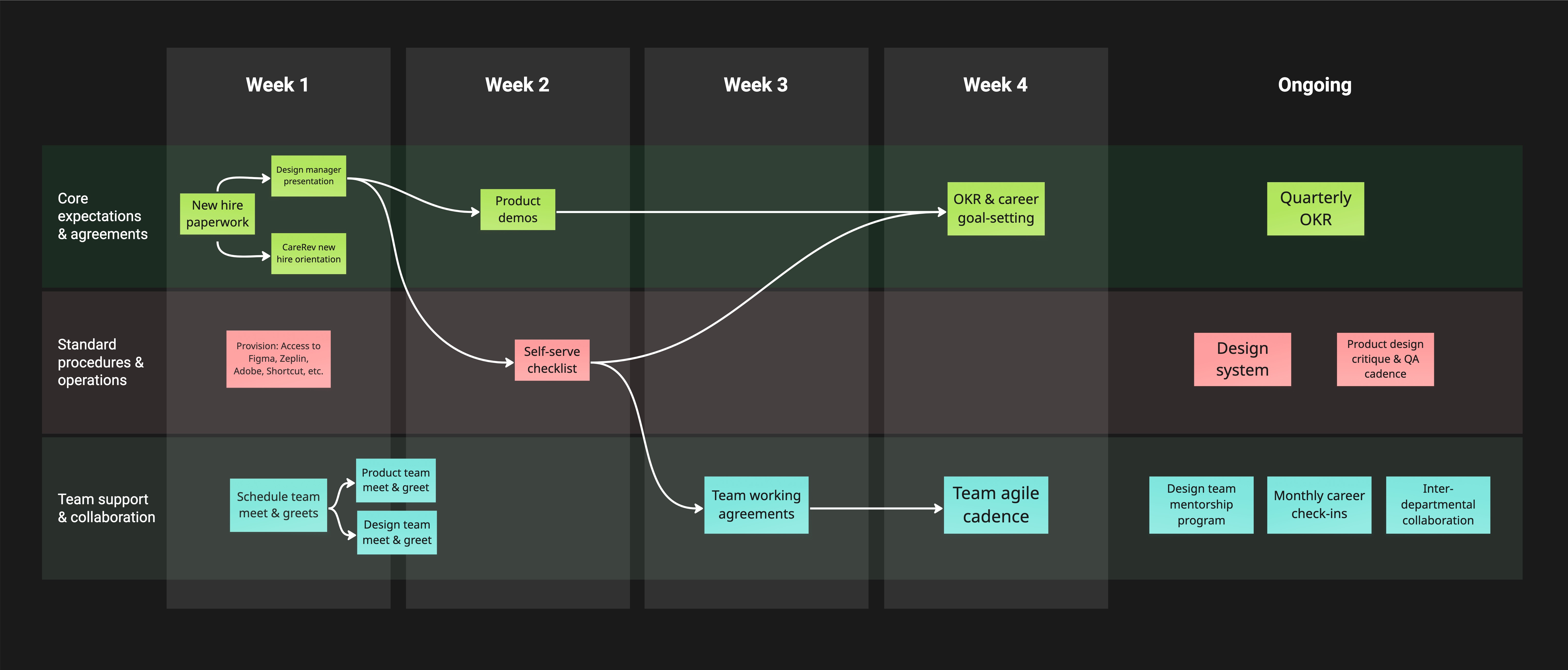
I worked with CareRev's Talent and Finance teams to set up a hiring pipeline that felt both fair and goal-oriented. This allowed me to hire a world-class team; but onboarding them in a way that produced a consistent design approach for our embedded structure was my sole responsibility. The workflow I created relied heavily on my Atomic approach, beginning at the core with CareRev's vision, mission and values, and ending with an Agile working style on each product-facing team. Each time I'd bring on new hires, I'd present them with this workflow in writing, and distribute it via our company's knowledgebase Wiki platform, Slab:
CareRev's brand vision: "We unite people in care."⇢
Informs team working agreements (Creative & each Product team)
Basic new hire onboarding workflow
Workflow #3: Support & resources
Goal: Quality & retention
Since our creative team's work was distributed, it was important to provide the right systems, SOPs, and resources to ensure quality work, a consistent customer experience, and employee career satisfaction.
My philosophy is that employee satisfaction sits at the core of quality work and customer experience, so that's where I started:
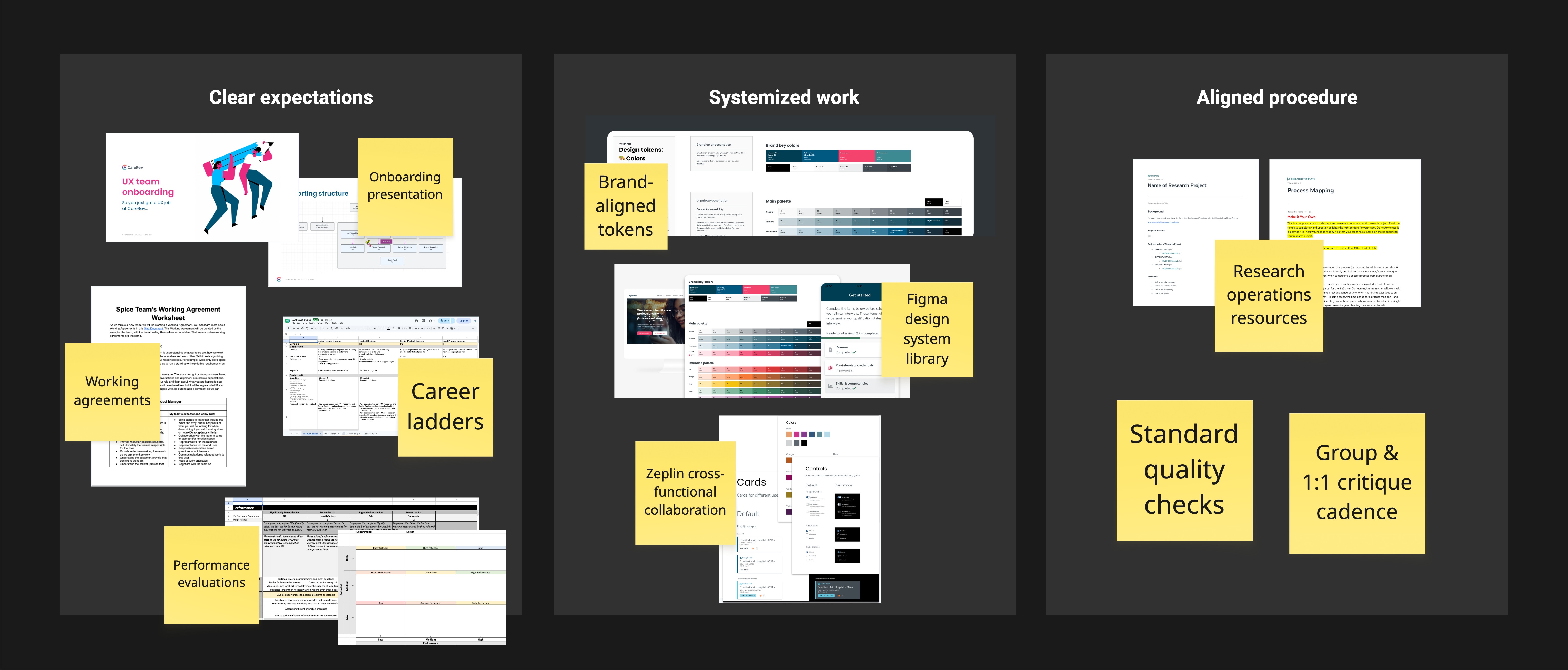
Candid & kind expectations: Working agreements, and performance expectations made in writing, published publicly in Slab to hold everyone accountable.
Systemized brand & design: Living atomic component library in Figma that centered around CareRev's visual identity.
Team alignment around procedures: Standard Operating Procedures for rigorous research practices, group & 1:1 critique, and QA of ready-to-ship designs.
Samples of resource artifacts provided to team
Outcomes & learnings
Flexibility with (necessary) room to iterate
You might have already guessed this, but not everything I built happened all at once! This was the power of approaching CareRev's creative model from an atomic, "small-to-big" lens. Our core identity and "why" became a fulcrum to pivot as-needed. And BOY did we need it!
With multiple executive changes, the team weathered many storms. Eventually, the brand-focused designers were moved into the Marketing Department under a different manager, while Product Design, Research, and Copy stayed with me, sharing resources when possible. By early 2023, I'd completed a new UX team vision (pictured below) to flow with new emerging company strategies involving AI, adjusted goals, and new leadership perspectives.
But "starting with Why" never changed. In my opinion, I believe that's why I retained 100% of my team members, and high satisfaction ratings from them on Employee Satisfaction Surveys conducted by PeopleOps in 2023.
The learning here is this: The constant of high-growth organizations will always be chaos! But an investment in people first will always provide a stable and even playing field where they thrive.